Contact person: Mr. Li
Tel: 138-4089-3242
138-8966-7314
Email: madapeng0729@163.com
website: www.dllsyj.cn
Address: houmu Industrial Zone, Yingchengzi Town, Ganjingzi District, Dalian
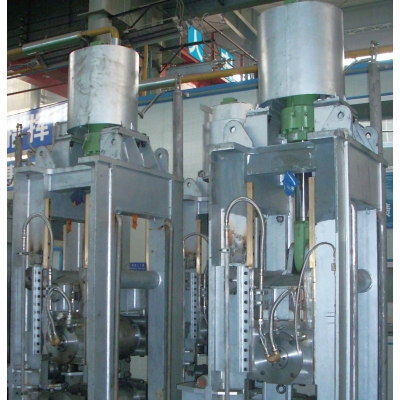
The anisotropic steel sector is a key component in metallurgical continuous casting equipment, mainly used to support and guide the casting billet, ensuring the stability and quality of the continuous casting process. The following are detailed technical parameters and indicators of the anisotropic steel sector:
1、 Basic structural parameters
Fan segment radius: usually 5-12 meters, determined according to the design of the arc radius of the continuous casting machine, directly affecting the degree of bending deformation of the cast billet. The radius accuracy requirement is ± 0.5mm/m.
Sector opening degree: refers to the maximum distance between the upper and lower frames, generally ranging from 200-400mm, with an adjustable range of ± 50mm to meet the needs of different thickness castings.
Fan segment length: The length of a single segment is usually 1.2-2.4 meters, and the length of each segment can be combined and designed according to process requirements, with a cumulative length error of no more than ± 1mm.
Roller arrangement: Adopting a dense arrangement of rollers, the roller spacing is usually 120-180mm, and can be increased to 80mm in special areas to ensure even support of the casting billet.
2、 Mechanical performance parameters
Bearing capacity: Static bearing capacity ≥ 300kN/m, dynamic bearing capacity ≥ 200kN/m, able to withstand the bulging force and thermal stress of the casting billet.
Frame stiffness: Under maximum load, the frame deflection is ≤ 0.3mm/m, ensuring that the deformation of the casting is controlled within the allowable range.
Alignment accuracy: The alignment error between each sector segment is ≤± 0.2mm, and the alignment accuracy of the roller is ≤± 0.1mm.
Vibration characteristics: Natural frequency ≥ 50Hz, avoid resonance with the frequency of continuous casting process, and control the amplitude within 0.05mm.
3、 Roller system parameters
Roller diameter: usually ranging from 120 to 200mm, adopting a stepped design with a larger inlet diameter and gradually decreasing outlet diameter.
Roll body length: 50-100mm larger than the width of the casting blank, ensuring full width support with a length tolerance of ± 0.5mm.
Roller material: Made of high-strength alloy steel, such as 42CrMo, H13, etc., with a surface hardness of HRC45-55 and a core hardness of HRC30-35.
Roller bearings: High temperature resistant double row cylindrical roller bearings are used, with a working temperature of up to 200 ℃ and a lifespan of ≥ 8000 hours.
Roller cooling: Internal cooling design, water flow rate 5-15L/min · roller, cooling water pressure 0.3-0.6MPa.
4、 Drive system parameters
Drive mode: electric mechanical drive or hydraulic drive, electric drive adopts servo motor, power 5.5-15kW.
Speed range: 0.5-3.0m/min stepless speed regulation, speed control accuracy ± 0.5%.
Transmission ratio: usually 10:1 to 20:1, ensuring sufficient torque output.
Position control: using a value encoder, with a repeated positioning accuracy of ± 0.05mm.
5、 Hydraulic system parameters
Working pressure: The rated pressure of the hydraulic system is 21MPa, with a maximum pressure of 25MPa.
Clamping force: The clamping force of a single roller can be adjusted from 20-50kN, and the total clamping force can reach over 500kN.
Response time: Hydraulic system response time ≤ 0.1s, ensuring quick adjustment.
Synchronization accuracy: Multi cylinder synchronization error ≤ ± 0.2mm.
6、 Cooling system parameters
Spray water volume: 10-30L/min · m ², automatically adjusted according to the casting temperature and pulling speed.
Nozzle layout: Adopting a matrix layout with a spacing of 80-120mm, covering the entire surface of the casting blank.
Water pressure control: The working pressure can be adjusted from 0.2-0.8MPa, and the pressure fluctuation is ≤± 5%.
Water quality requirements: suspended solids ≤ 50mg/L, hardness ≤ 100mg/L, pH value 6.5-8.5.
7、 Electrical control system parameters
PLC control: Industrial grade PLC is used, with a scanning cycle of ≤ 10ms and I/O points of ≥ 256.
HMI interface: touch screen of 15 inches or more, refresh rate ≥ 60Hz, supports multi language switching.
Communication protocol: Supports mainstream industrial communication protocols such as PROFIBUS-DP and Ethernet/IP.
Sensor accuracy: Temperature sensor ± 1 ℃, displacement sensor ± 0.01mm, pressure sensor ± 0.5% FS.
8、 Materials and Manufacturing Parameters
Frame material: Made of Q345B or ASTM A572 Gr.50 low-alloy high-strength steel, with stress relief treatment after welding.
Processing accuracy: The coaxiality of the bearing seat hole is ≤ 0.02mm, and the flatness of the installation surface is ≤ 0.05mm/m.
Surface treatment: The key friction surface is treated with hard chrome plating, with a thickness of 0.05-0.1mm and a hardness of ≥ HRC60.
Assembly accuracy: roller parallelism ≤ 0.1mm/m, roller gap uniformity ≤ ± 0.15mm.
9、 Using environmental parameters
Working temperature: -20 ℃ to+200 ℃, can withstand high temperatures of 300 ℃ in the short term.
Environmental humidity: ≤ 90% RH (no condensation).
Seismic grade: capable of withstanding vibrations with a horizontal acceleration of 0.3g.
Protection level: IP54 for electrical components and IP23 for mechanical components.
10、 Reliability index
Mean time between failures: MTBF ≥ 5000 hours.
Service life: Core components have a lifespan of ≥ 8 years or a steel production capacity of 1.5 million tons.
Maintenance cycle: Planned maintenance interval ≥ 3 months.
Spare parts replacement time: Single roller replacement ≤ 2 hours, whole section replacement ≤ 8 hours.
The above parameters constitute a complete technical index system for the anisotropic steel sector. In practical applications, adjustments and optimizations need to be made according to specific continuous casting process requirements to ensure better matching between equipment performance and production processes.
 Company service hotline:
 Address: houmu Industrial Zone, Yingchengzi Town, Ganjingzi District, Dalian